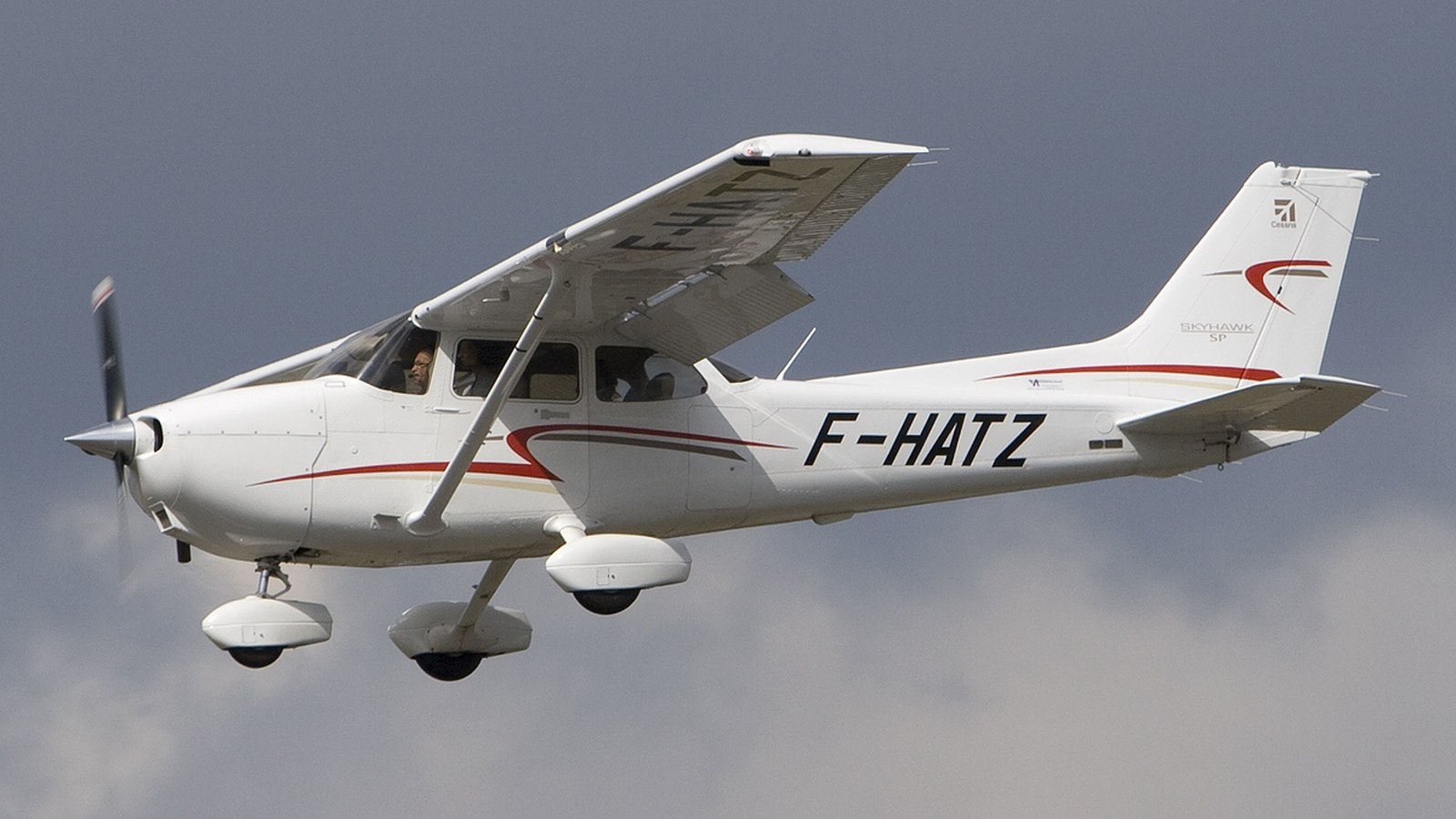
Buyer's Guide · 11 min read
Buying a Used Cessna 172 in 2026: What I Wish Someone Had Told Me
Real prices, the pre-buy mistakes most first-time buyers make, and how to walk away from the wrong airplane — written by a pilot who has done this the wrong way and lived to write about it.
Daniele Forciniti
VDS pilot since 2003 · Co-founder of MarketplaceAviation · Updated May 2026
The first used 172 I ever looked at was parked behind a hangar at a small airfield outside Arezzo, in the summer of 2008. It was a 1974 172M with sun-faded paint, an honest 2,800 hours total time, and a price that — to a kid who had earned his VDS licence five years earlier — sounded like a typo. I almost bought it on the spot. A friend with thirty years in the business pulled me aside in the parking lot and asked me one question: "Have you seen the logbooks?"
I had not. We went back inside, asked for them, and what we found was the kind of paperwork gap that quietly cuts the value of an airplane in half. The seller had no documentation for two engine top overhauls done sometime in the late 1990s. No invoices, no signatures, no way to verify what was actually inside that engine. The price was right. The airplane was not.
I walked away. I have been thinking about that day every time I have looked at an airplane since — and after running a marketplace where thousands of pilots browse used 172s every week, I have noticed that the same handful of mistakes keep coming back. So here is the guide I wish I had been handed in 2008.
Why the 172 still wins
There is no aircraft on the planet that has been built in greater numbers than the Cessna 172 Skyhawk. More than 44,000 of them since 1956. That sheer volume is the single most important fact for any buyer — because it means three very specific things.
Parts are everywhere. A wing strut, a cowling, a magneto, an alternator — somebody, somewhere in your country, has the one you need on a shelf. Try sourcing those parts for a Socata Tobago or a Robin DR400 and you will quickly understand why this matters.
Mechanics know it. Whether you fly out of Texas, Tuscany, or Tasmania, the local A&P or AME has worked on a 172 before. Probably last week. That keeps annual inspection costs predictable and surprises rare.
Resale is reliable. A 172 in good condition holds its value better than almost any other piston single on the market. If life changes and you have to sell, you will not be the only one who needs that airplane.
None of this is to say the 172 is the perfect airplane. It is slow (about 122 knots true at altitude), it carries less than a Cherokee 180 when fully fuelled, and the high wing makes preflight a small workout if you are not tall. But for a first airplane, for a flight school, for a weekend traveller, for a pilot who values time-tested reliability over speed — there is nothing else even close.
What you should actually pay
Asking prices on listing sites are, generously, "aspirational." What an airplane actually sells for is usually 8–15% below the ask, sometimes more if the airplane has been on the market past 90 days. With that caveat, here is what the 2026 market looks like for a Cessna 172 in honest, flyable, no-major-surprises condition.
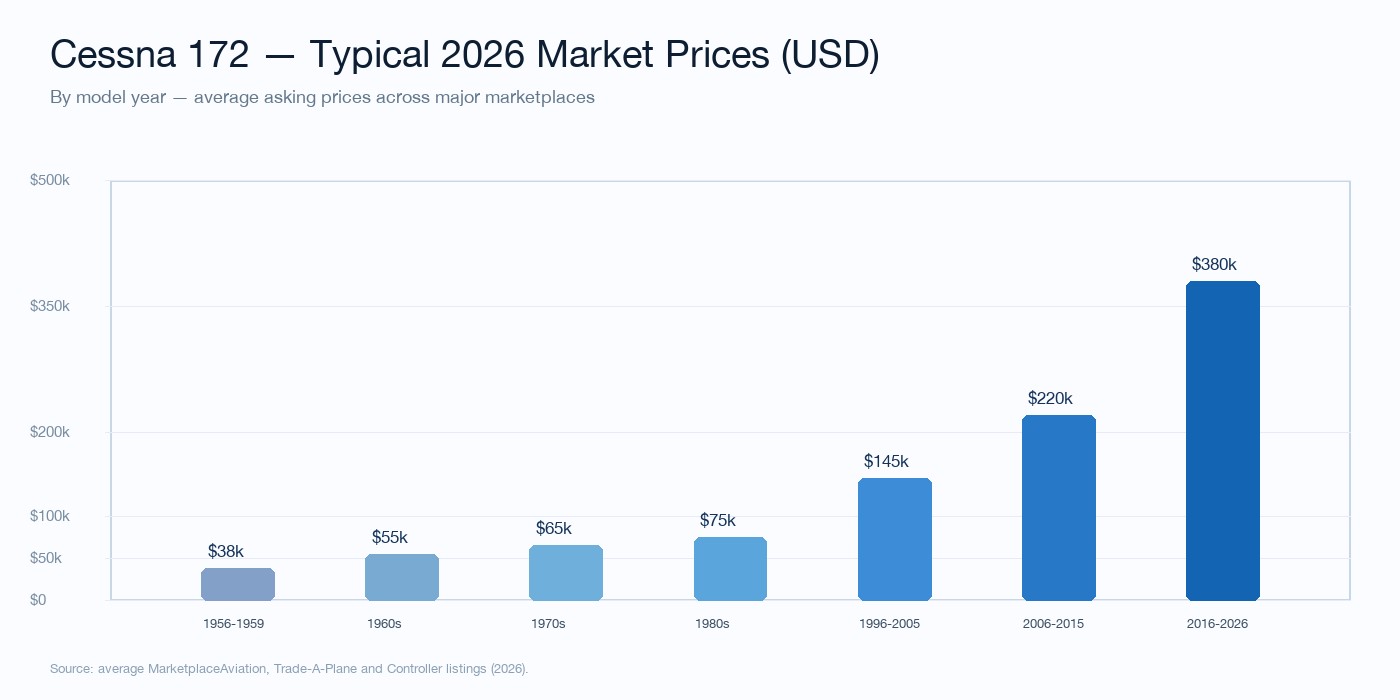
The numbers that matter most for most buyers sit in the middle of that chart. A 1970s 172M or 172N with a mid-time O-320 (around 1,000–1,400 hours since major overhaul), current annual, modern transponder, and decent paint and interior, will trade between $60,000 and $85,000 almost anywhere in the Western world. That same airframe with a fresh engine, fresh paint and a Garmin GTN 650 in the panel jumps to $95,000–$115,000.
If you are tempted by something below $50,000, slow down. There is almost always a reason. It might be an engine close to TBO with calendar years adding up. It might be paperwork that needs reconstructing. It might be a damage history that has been patched but not properly written up. Bargains exist — I am not saying they do not. But for every real $40,000 honest 172 out there, there are five that will end up costing you $80,000 before you can legally fly them.
Logbooks: the part nobody wants to read
If you only do one thing on the day you go to look at an airplane, do this: sit down with the logbooks for an hour before you even open the hangar door. Bring coffee. Have the airframe and engine books in front of you and read them in chronological order.
What you are looking for is not glamour. You are looking for boredom. Continuous annual inspections every twelve months without a gap. A clean record of every Airworthiness Directive being addressed within its compliance deadline. Engine overhauls — major or top — with the shop name, the invoice number, and the specific work performed listed clearly. Avionics installations signed off by a shop and not handwritten in the margin.
What you do not want to see: ten-year periods with no entries. "Sat in hangar" written across multiple annuals. Logbook signatures that go from black ink to ballpoint blue to pencil. Sticky notes. Loose pages. White-out. If the seller hesitates to let you take the logbooks home for an evening, that is information too. A confident seller of a clean airplane wants you to read them.
The truth about engines and hours
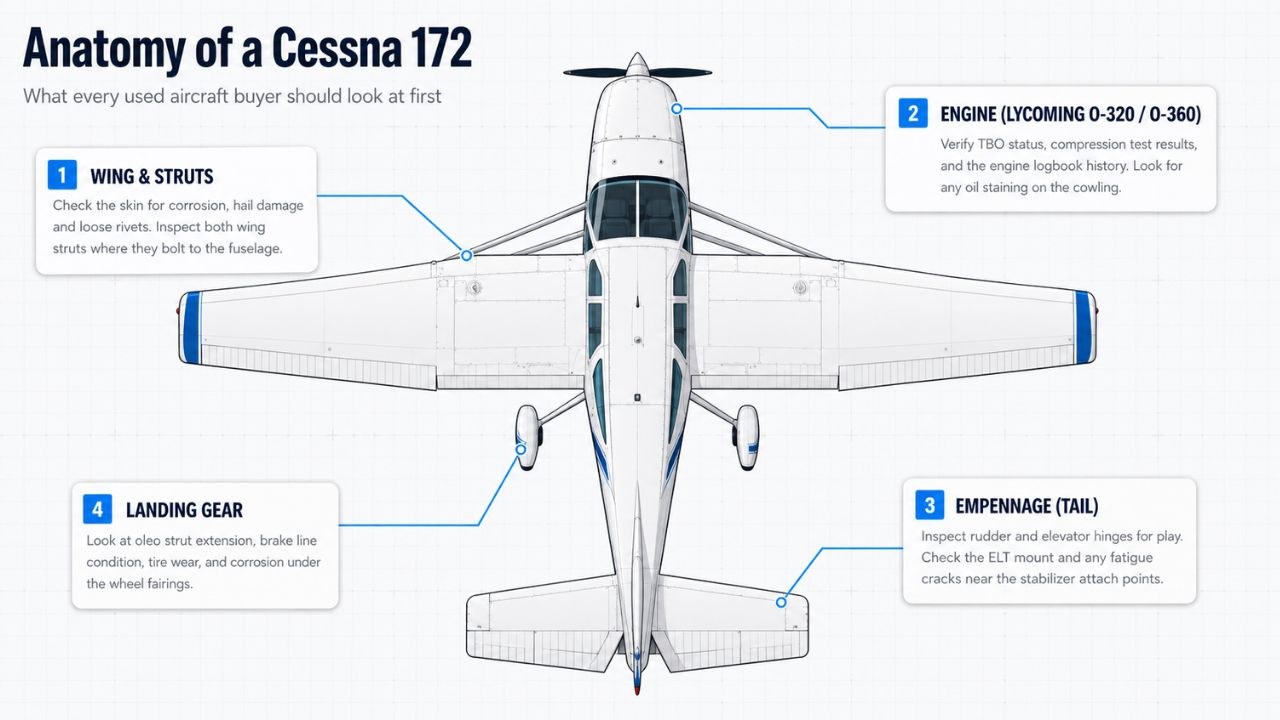
Both engines you will find on a 172 — the Lycoming O-320 (most years) and the larger O-360 (older variants, modified airframes) — have a manufacturer-published TBO of 2,000 hours. New pilots tend to read that number as a countdown clock. It is not. It is a guideline, and it is one that experienced owners interpret with a great deal of nuance.
An engine with 1,800 hours since overhaul that has been flown 120 hours a year, kept hangared, oil changed religiously every 25 hours, and run with cylinders in the 75/80 compression range, is usually in better health than the same engine at 600 hours that has spent the last decade flying 20 hours a year and sitting out in the rain.
What kills engines is not hours. It is calendar time, moisture, and disuse. The number you should care about almost as much as the SMOH is when the last oil change happened, how often the airplane has actually flown in the last three years, and where it has been parked.
One last thing: ask for the most recent oil analysis report. Any owner who is taking the airplane seriously will have one. The presence of metals in the oil — particularly iron, copper, or aluminium — tells you more about the real condition of the engine than a hundred logbook entries.
The pre-buy inspection, and why you cannot skip it
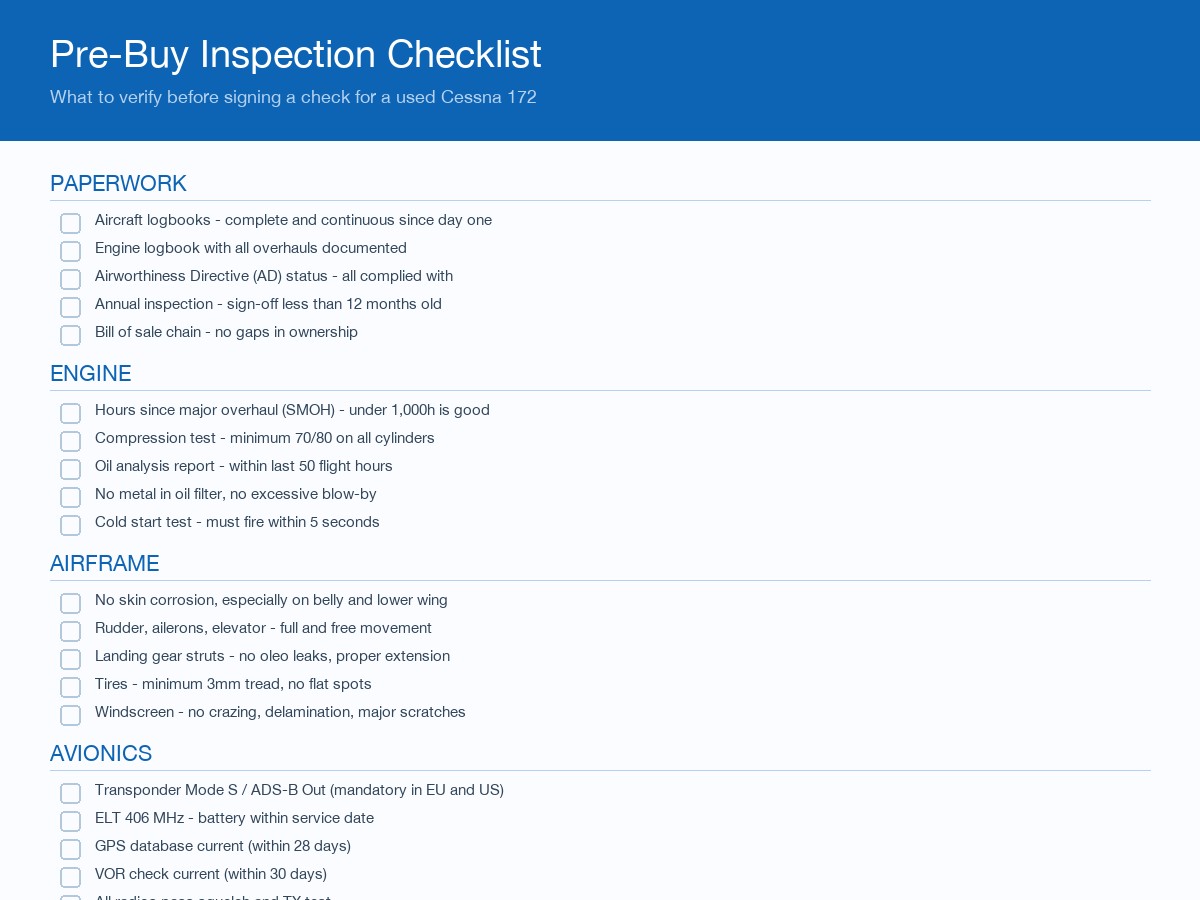
I have written about this in the past and I will write about it again: there is no decision in the entire buying process that returns more value than a proper independent pre-buy inspection. Budget $500 to $1,500 depending on your region. Use an A&P (in the US) or an AME (in most of Europe) who does not work for the seller and has no relationship with the airplane's history.
A good pre-buy goes far beyond a visual walk-around. It includes compression testing on every cylinder, a borescope inspection of cylinder walls and valves, verification of all open Airworthiness Directives, a careful review of the logbooks (which is where most pre-buys discover the biggest issues), and a test flight where the airplane goes through every system — climb, cruise, descent, avionics, electrical, fuel, flaps, trim — under load.
The inspector should hand you a written report. If the airplane passes, you have paid for peace of mind. If the airplane fails, you have paid for the cheapest education of your life.
When to walk away
I have walked away from four airplanes in my flying life. Three of them I would walk away from again tomorrow. Here, in no particular order, are the red flags that should make you reach for your car keys.
The seller refuses an independent pre-buy. No legitimate reason exists for this. None. Walk.
Logbook gaps that cannot be reconstructed. Six months missing in 1987 is not a problem. Six years missing across two different owners is a problem you may never recover from at resale.
Recent damage history that nobody wants to talk about. Wrinkled skin under fresh paint. New rivets in a pattern that does not match the surrounding airframe. A nose gear that has obviously been replaced on an airplane that "has never had any damage."
An annual that has just been completed by the seller's own shop two days before you arrived to look at it. Get a second opinion before that sign-off ink is dry.
Pressure to close fast. "Another buyer is coming Saturday." "I need to move it before Monday." Real airplanes do not sell in twenty-four hours, and serious sellers know that.
Where to look in 2026
In the US market, Trade-A-Plane and Controller still dominate the broker and dealer side. Barnstormers tends to have the most interesting vintage and project airplanes, often from private sellers. AFORS remains the go-to for the UK and most of Europe. Local boards like Annunci Aerei in Italy or VoloMarket in Spain are smaller but tend to have airplanes you will not see anywhere else.
We built MarketplaceAviation specifically for the segment that the big established sites were not serving well: private pilots selling their own airplanes directly to other private pilots, for free, anywhere in the world. There is no commission on a sale. There is no listing fee. There is a built-in secure chat so the conversation about a specific airplane stays attached to that airplane. We took the parts of the buying process we found genuinely annoying as buyers, and tried to design them out.
Whichever board you use, the search discipline is the same. Save searches on multiple sites. Set up email alerts. Be patient. The right airplane for you is being listed somewhere this week. The right airplane is rarely the first one you look at.
A last thought from the parking lot
That 1974 172M I almost bought in 2008 sold three months later for about 35% less than the original ask. I heard from the friend who pulled me aside that the buyer ended up replacing both magnetos, one cylinder, the cowling, and most of the wiring harness before he could fly it legally. By the time he was done he had paid more than a properly documented Skyhawk would have cost him in the first place.
Buying an aircraft is, more than anything, an exercise in not getting in your own way. The romance of the airplane in front of you is real. The temptation to sign the check at the end of a long day is real. The voice that says "this is the one and you will not find another like it" is wrong about 90% of the time.
Bring a friend. Read the logbooks. Pay for the pre-buy. Walk away from the first three. The fourth one will fly you to places that the first three never could have.
Daniele Forciniti earned his VDS (Volo da Diporto o Sportivo) licence in 2003 at Aeroclub Serristori in Arezzo, Tuscany. He has been flying ultralights and light aircraft across Italy, Spain and the rest of Europe since then. In 2026 he co-founded and developed MarketplaceAviation, the free worldwide marketplace for buying and selling aircraft and aviation parts. He lives in Spain.
Frequently Asked Questions
The questions buyers actually ask me
How much does a used Cessna 172 cost in 2026? +
Used Cessna 172 prices in 2026 range roughly from $35,000 for an early 1950s straight-tail with high time, up to $400,000 or more for a recent 172S with G1000 NXi avionics. A clean 1970s–1980s Skyhawk with a mid-time engine typically sells for $55,000–$85,000, while the 1996–2005 restart models (172R, early 172S) usually sit between $120,000 and $170,000.
What is the single most important thing to check before buying? +
Documentation. Complete and continuous aircraft and engine logbooks since day one, every Airworthiness Directive complied with on time, and a current annual inspection. A perfect-looking airplane with missing logbooks is worth dramatically less and may not even be insurable.
How many engine hours is too many on a Cessna 172? +
The published TBO on both the O-320 and O-360 is 2,000 hours. An engine with 1,400–1,800 hours since major overhaul is reaching end-of-life and you should budget $25,000–$35,000 for a major overhaul. Under 1,000 hours SMOH is considered fresh. But calendar matters as much as hours: an engine that has not run regularly is often in worse shape than one with high hours and regular use.
Do I really need a pre-buy inspection? +
Yes — and always by an independent A&P or AME, never the seller's mechanic. A proper pre-buy costs $500–$1,500 and typically saves the buyer 5x to 20x that amount in discovered defects, missed ADs, or hidden corrosion. Walking away from a bad airplane after a pre-buy is cheap. Walking away from one after you have signed is expensive.
Is a 1970s 172 still a sensible buy? +
For most pilots, yes. A 1970s 172M or 172N with a recently overhauled engine, modern Garmin avionics, and clean paperwork is the sweet spot of the whole used market. Acquisition cost is reasonable ($60k–$85k), parts are everywhere, operating costs are predictable, and the airframe is essentially the same as the new $400,000 ones. The catch: condition varies enormously, so the pre-buy is non-negotiable.
Where should I be searching for used 172s in 2026? +
The widest selection in 2026 sits on MarketplaceAviation, Trade-A-Plane, Controller and Barnstormers. Each has its strengths: Trade-A-Plane and Controller carry the most US listings, MarketplaceAviation is free for both buyers and sellers with worldwide reach, and Barnstormers tends to attract unique vintage and project airplanes. For European buyers, AFORS in the UK and Annunci Aerei in Italy are also worth checking.
Looking for your 172?
We built MarketplaceAviation to be the kind of place where finding the right airplane is patient, transparent and free. Browse what is for sale today, or save a search and let the airplane find you.